
13 Types of Virtual Assistant Services for Businesses
Table of Contents
What Are Virtual Assistant Services?
13 Types of Virtual Assistant Services Businesses Can Use
1. Administrative Virtual Assistant
2. Executive Virtual Assistant
3. Customer Service Virtual Assistant
4. Social Media Virtual Assistant
5. Digital Marketing Virtual Assistant
6. Bookkeeping Virtual Assistant
7. Data Entry Virtual Assistant
8. E-commerce Virtual Assistant
9. Real Estate Virtual Assistant
10. Content Writing Virtual Assistant
11. Graphic Design Virtual Assistant
12. Technical Virtual Assistant
13. Project Management Virtual Assistant
Which Type of Virtual Assistant Does Your Business Need?
What Are the Benefits of Hiring a Virtual Assistant?
Better Operational Consistency
Why Hire a Filipino Virtual Assistant?
How to Choose the Right Virtual Assistant
Identify Tasks You Want to Delegate
Provide Proper Training and Documentation
Monitor Performance and Provide Feedback
Can AI and Virtual Assistants Work Together?
Frequently Asked Questions About Virtual Assistant Services
1. What are the most common virtual assistant services?
2. What is the difference between a general and specialized virtual assistant?
3. Can I hire a Filipino virtual assistant for my small business?
4. How much do virtual assistant services cost?
Running a business involves more than delivering products or services. From answering customer inquiries and managing schedules to creating marketing content and tracking finances, daily responsibilities can quickly become overwhelming.
For small business owners, entrepreneurs, and growing companies, handling every task internally isn’t always practical. Hiring additional employees can increase overhead expenses, while managing everything alone can limit productivity and business growth.
This is where virtual assistant services become valuable.
Virtual assistants (VAs) are remote professionals who provide administrative, technical, creative, and operational support. Depending on their expertise, they can manage routine responsibilities or perform specialized tasks that help businesses operate more efficiently.
Understanding the different types of virtual assistant services can help you determine which responsibilities to delegate and what kind of support your business needs. Many companies also choose Filipino virtual assistants for administrative, marketing, customer service, and specialized business support, making the Philippines a popular destination for remote staffing.
What Are Virtual Assistant Services?
Virtual assistant services are professional support services delivered remotely. Businesses hire virtual assistants to handle specific tasks, manage recurring responsibilities, or support entire departments without requiring employees to work from a physical office.
These services can include administrative assistance, customer support, marketing, bookkeeping, technical support, and project coordination.
Unlike traditional office-based employees, virtual assistants typically work through online communication platforms, cloud-based software, and digital collaboration tools.
Businesses can hire virtual assistants on a part-time, full-time, or project-based arrangement, depending on their requirements.
The right virtual assistant can help reduce administrative workloads, improve operational efficiency, and give business owners more time to focus on strategic priorities.
13 Types of Virtual Assistant Services Businesses Can Use
Not every virtual assistant performs the same responsibilities. Some specialize in administrative tasks, while others focus on technical operations, marketing, customer service, or industry-specific support.
Here are 13 types of virtual assistant services and how they can help your business.
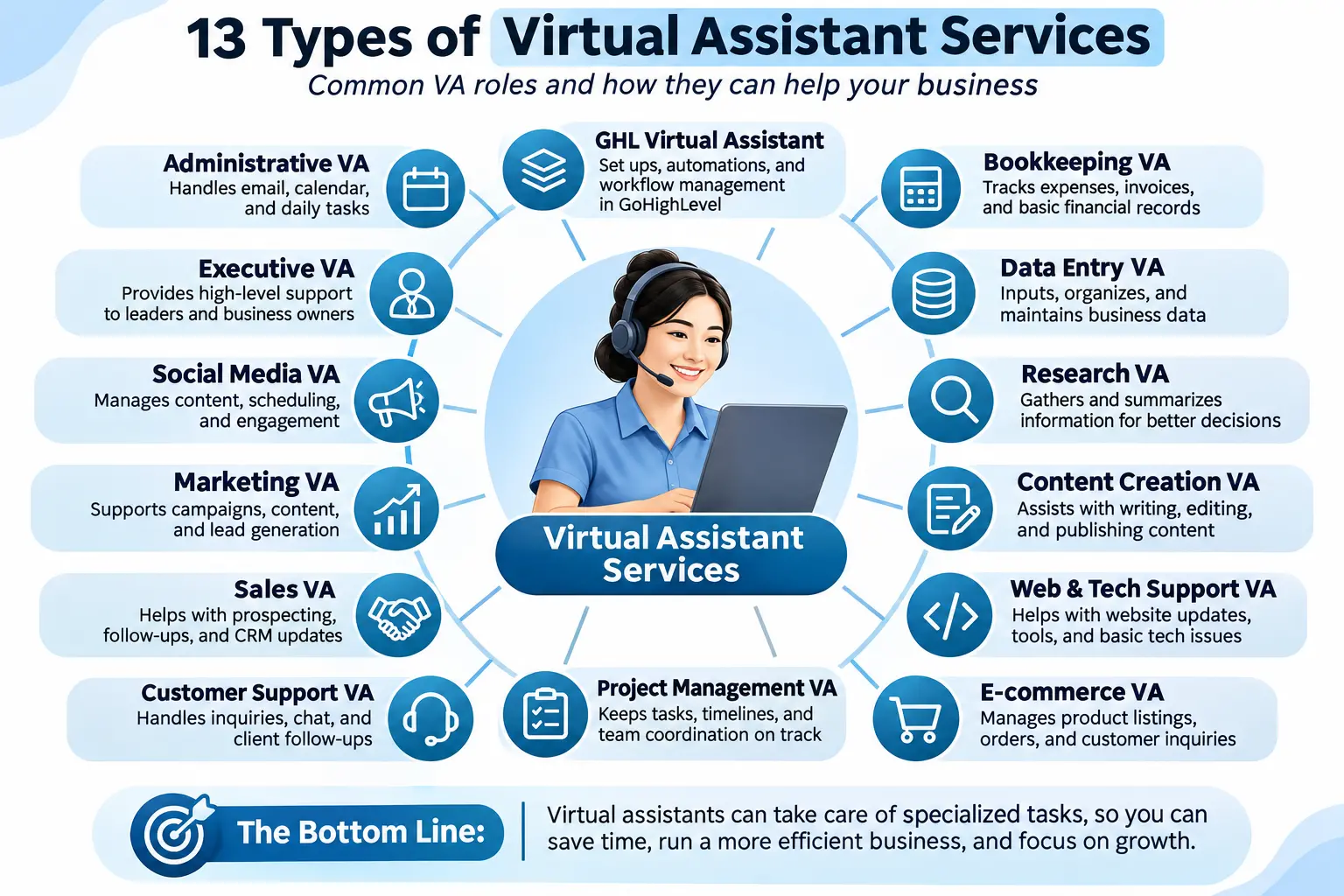
1. Administrative Virtual Assistant
Administrative virtual assistants handle routine office responsibilities that keep business operations organized.
These professionals are particularly helpful for entrepreneurs, executives, and small business owners who spend too much time managing emails, appointments, and documents.
Common responsibilities include:
Managing email inboxes and organizing messages
Scheduling appointments and meetings
Updating calendars and sending reminders
Preparing reports and business documents
Organizing digital files and records
Coordinating travel arrangements
Maintaining contact databases
How they help your business:
An administrative virtual assistant reduces the time spent on repetitive office tasks. Instead of managing calendars and organizing documents throughout the day, business owners can focus on clients, business development, and important decisions.
For example, a consultant who spends several hours each week scheduling meetings and responding to routine emails could delegate those responsibilities to an administrative VA.
2. Executive Virtual Assistant
Executive virtual assistants provide specialized administrative and organizational support to business owners, CEOs, managers, and other senior professionals.
While administrative assistants typically handle general office tasks, executive assistants often manage more complex responsibilities requiring discretion, coordination, and independent judgment.
Common responsibilities include:
Managing executive calendars
Coordinating meetings with clients and stakeholders
Preparing meeting agendas and summaries
Organizing business travel
Tracking important deadlines
Managing executive correspondence
Following up on assigned action items
How they help your business:
An executive virtual assistant helps business leaders manage competing priorities and maintain organized schedules.
For example, a CEO managing multiple departments can delegate meeting coordination, follow-up communication, and calendar management to an executive assistant.
This allows leadership to concentrate on strategic planning, partnerships, and business performance.
3. Customer Service Virtual Assistant
Customer service virtual assistants manage communication between businesses and their customers.
They respond to inquiries, resolve common concerns, and help customers receive timely assistance through different communication channels.
Common responsibilities include:
Responding to customer emails
Managing live chat inquiries
Answering incoming calls
Processing routine service requests
Updating customer support tickets
Providing order and delivery updates
Escalating complex issues to appropriate team members
How they help your business:
Customer service virtual assistants help businesses maintain consistent communication without requiring owners to respond to every inquiry personally.
For example, an online retailer receiving dozens of daily questions about shipping, product availability, and returns can delegate routine inquiries to a customer support VA.
This can improve response times and create a more organized customer experience.
4. Social Media Virtual Assistant
A social media virtual assistant helps businesses maintain an active and organized presence across social media platforms.
These professionals support content scheduling, audience engagement, and performance monitoring.
Common responsibilities include:
Creating social media content calendars
Scheduling posts across platforms
Writing captions and promotional content
Responding to comments and messages
Monitoring social media engagement
Researching relevant trends and topics
Preparing social media performance reports
How they help your business:
Consistent social media activity requires planning, creativity, and ongoing engagement.
A social media virtual assistant can manage these recurring responsibilities while business owners focus on delivering services and generating revenue.
For example, a local service provider can delegate weekly content scheduling, customer message monitoring, and basic engagement tracking to a social media VA.
This helps maintain brand visibility without consuming the owner’s entire workday.
Businesses looking for dedicated support can explore BusyVeez’s social media management services to learn more about delegating social media responsibilities.
5. Digital Marketing Virtual Assistant
Digital marketing virtual assistants support businesses with online marketing activities designed to attract visitors, generate leads, and improve brand awareness.
Their responsibilities may cover several marketing channels, depending on their experience.
Common responsibilities include:
Conducting keyword research
Supporting search engine optimization (SEO)
Preparing email marketing campaigns
Updating website content
Monitoring marketing analytics
Creating campaign reports
Coordinating promotional activities
Managing marketing automation workflows
How they help your business:
Digital marketing requires consistent execution and performance monitoring.
A marketing virtual assistant can help maintain ongoing campaigns, organize marketing assets, and support lead-generation activities.
For example, a growing business might delegate blog publishing, email campaign preparation, and monthly marketing reports to a digital marketing VA.
Specialized tasks such as advanced SEO strategy or paid advertising optimization may require additional expertise.
6. Bookkeeping Virtual Assistant
Bookkeeping virtual assistants help businesses maintain organized financial records and complete routine bookkeeping activities.
They typically work with accounting software and financial documentation under the supervision of business owners or qualified accounting professionals.
Common responsibilities include:
Recording financial transactions
Organizing invoices and receipts
Tracking accounts payable and receivable
Reconciling bank transactions
Preparing basic financial summaries
Monitoring outstanding invoices
Updating bookkeeping software
How they help your business:
Accurate financial records help business owners understand expenses, monitor cash flow, and prepare for financial reporting.
For example, a small business owner who struggles to organize invoices and transaction records can delegate routine bookkeeping tasks to a qualified VA.
However, bookkeeping virtual assistants should not replace licensed accountants when professional accounting, tax, or regulatory expertise is required.
7. Data Entry Virtual Assistant
Data entry virtual assistants specialize in organizing, updating, and maintaining business information across digital systems.
Although these responsibilities may appear simple, accurate data management is essential for efficient operations.
Common responsibilities include:
Entering information into databases
Updating customer records
Maintaining spreadsheets
Organizing contact lists
Transferring data between platforms
Cleaning duplicate records
Updating customer relationship management (CRM) systems
How they help your business:
A data entry virtual assistant reduces the administrative burden of maintaining accurate business information.
For example, a sales team managing hundreds of customer records can delegate database updates and CRM maintenance to a data entry VA.
This helps sales representatives spend more time communicating with prospects rather than manually updating records.
8. E-commerce Virtual Assistant
E-commerce virtual assistants support businesses that sell products through online stores and digital marketplaces.
They help manage product information, order-related tasks, and customer communication.
Common responsibilities include:
Uploading product listings
Updating product descriptions
Monitoring inventory information
Processing routine order updates
Responding to customer inquiries
Coordinating shipping information
Organizing product images
Maintaining online store records
How they help your business:
Managing an online store involves numerous daily responsibilities beyond selling products.
An e-commerce virtual assistant can help keep product information accurate, monitor orders, and maintain communication with customers.
For example, an online clothing store can delegate product uploads, inventory updates, and order tracking to an e-commerce VA.
This allows the business owner to focus on product development, supplier relationships, and sales strategies.
9. Real Estate Virtual Assistant
Real estate virtual assistants provide administrative and marketing support to real estate agents, brokers, and property management businesses.
They help professionals manage listings, appointments, customer communication, and transaction-related documentation.
Common responsibilities include:
Updating property listings
Scheduling property viewings
Organizing client information
Following up with prospective buyers and sellers
Preparing marketing materials
Managing CRM databases
Coordinating transaction paperwork
Tracking important deadlines
How they help your business:
Real estate professionals often balance client meetings, property showings, paperwork, and lead generation.
A real estate virtual assistant can handle routine administrative work so agents can focus on client relationships and property transactions.
For example, an agent managing several listings can delegate appointment scheduling, listing updates, and lead follow-ups to a virtual assistant.
Tasks requiring a real estate license must remain with appropriately licensed professionals.
10. Content Writing Virtual Assistant
Content writing virtual assistants help businesses create written materials for websites, blogs, newsletters, and digital marketing campaigns.
These professionals support content production and help maintain consistent communication with target audiences.
Common responsibilities include:
Writing blog articles
Preparing website content
Drafting email newsletters
Creating social media captions
Researching content topics
Editing existing articles
Updating outdated content
Formatting and publishing blog posts
How they help your business:
Producing useful content consistently takes time and research.
A content writing virtual assistant can support a company’s publishing schedule and help maintain its online presence.
For example, a business publishing four blog articles each month could delegate topic research, first drafts, formatting, and content uploads to a writing VA.
Subject-matter experts or editors should still review content that requires specialized knowledge, legal accuracy, or medical expertise.
11. Graphic Design Virtual Assistant
Graphic design virtual assistants create visual materials that support branding, marketing, and business communication.
They may work on recurring design tasks or individual creative projects.
Common responsibilities include:
Designing social media graphics
Creating promotional banners
Preparing presentation slides
Editing marketing images
Designing email graphics
Producing simple infographics
Updating branded templates
Preparing basic advertising visuals
How they help your business:
Professional-looking visuals can improve the consistency and presentation of marketing materials.
A graphic design virtual assistant helps businesses produce recurring visual content without requiring owners to create every asset themselves.
For example, a marketing agency managing multiple client accounts can delegate social media graphics and promotional designs to a graphic design VA.
This supports faster content production and more consistent branding.
12. Technical Virtual Assistant
Technical virtual assistants provide remote support for software, websites, business platforms, and digital workflows.
Their responsibilities depend on their technical knowledge and the systems used by the business.
Common responsibilities include:
Updating website content
Managing website plugins
Troubleshooting basic software issues
Configuring CRM workflows
Supporting email marketing integrations
Maintaining digital tools
Assisting with website backups
Documenting technical processes
How they help your business:
Technical problems and software maintenance can interrupt business operations.
A technical virtual assistant helps manage routine digital responsibilities and provides support when common issues arise.
For example, a business using multiple marketing and CRM platforms can delegate workflow maintenance, website updates, and basic troubleshooting to a technical VA.
Businesses using GoHighLevel can also explore specialized GoHighLevel virtual assistant support for CRM management and workflow assistance.
Complex cybersecurity, infrastructure, and software development tasks should be assigned to professionals with the appropriate technical qualifications.
13. Project Management Virtual Assistant
Project management virtual assistants help teams organize tasks, monitor deadlines, and coordinate communication across ongoing projects.
They are particularly useful for businesses managing multiple clients, campaigns, or internal initiatives.
Common responsibilities include:
Creating project task lists
Updating project management platforms
Tracking deadlines and milestones
Coordinating team meetings
Preparing progress reports
Following up on pending tasks
Organizing project documentation
Communicating project updates
How they help your business:
A project management virtual assistant helps maintain visibility over ongoing work and reduces the risk of overlooked responsibilities.
For example, a digital agency managing several website development projects can delegate task tracking, deadline reminders, and status updates to a project coordination VA.
This allows project managers and team leaders to concentrate on planning, problem-solving, and client relationships.
Which Type of Virtual Assistant Does Your Business Need?
Choosing the right virtual assistant depends on your business operations, recurring challenges, and the tasks consuming the most time.
The following table can help identify which type of virtual assistant may be most useful.
Business Need | Recommended Virtual Assistant |
Managing emails, schedules, and documents | Administrative VA |
Supporting executives and business leaders | Executive VA |
Responding to customer inquiries | Customer Service VA |
Managing social media accounts | Social Media VA |
Supporting SEO and marketing campaigns | Digital Marketing VA |
Organizing financial records | Bookkeeping VA |
Updating databases and spreadsheets | Data Entry VA |
Managing online store operations | E-commerce VA |
Supporting property listings and agents | Real Estate VA |
Creating articles and website content | Content Writing VA |
Designing marketing visuals | Graphic Design VA |
Maintaining websites and digital tools | Technical VA |
Coordinating tasks and deadlines | Project Management VA |
Before hiring, identify which responsibilities are repetitive, time-consuming, or preventing your team from focusing on higher-value activities.
You may discover that one general virtual assistant can manage several related responsibilities, while specialized tasks require someone with additional experience.
What Are the Benefits of Hiring a Virtual Assistant?
Hiring a virtual assistant can provide several operational advantages, particularly for small businesses and growing organizations.
Reduced Operational Costs
Virtual assistants work remotely, which can reduce the need for additional office space, equipment, and other location-based expenses.
However, actual savings depend on the hiring arrangement, compensation, management requirements, and services provided.
Improved Time Management
Delegating repetitive tasks allows business owners and employees to spend more time on responsibilities that require their expertise.
For example, outsourcing routine appointment scheduling and email organization can create additional time for client meetings and business development.
Access to Specialized Skills
Businesses can hire virtual assistants with experience in specific areas such as digital marketing, graphic design, bookkeeping, or technical support.
This provides access to skills that may not be available within an existing team.
Flexible Business Support
Virtual assistants can support businesses through different working arrangements, including part-time, full-time, and project-based services.
This flexibility allows companies to adjust support based on workloads and operational requirements.
Better Operational Consistency
Assigning recurring responsibilities to a dedicated virtual assistant can help ensure that routine tasks are completed consistently.
Examples include updating customer records, responding to inquiries, and maintaining project documentation.
Why Hire a Filipino Virtual Assistant?
Filipino virtual assistants provide remote administrative, creative, technical, and customer support services to businesses worldwide. The Philippines has become a popular outsourcing destination because of its established business process outsourcing industry and workforce experienced in supporting international clients.
Businesses hire Filipino virtual assistants for several reasons:
English communication skills: Many Filipino professionals have experience communicating with English-speaking clients.
Cost-effective support: Hiring remotely from the Philippines may reduce staffing expenses compared with some domestic hiring arrangements.
Flexible working schedules: Filipino virtual assistants may accommodate different time zones depending on the agreed working arrangement.
Specialized expertise: Professionals offer services ranging from executive assistance and social media management to bookkeeping and technical support.
Familiarity with digital tools: Many experienced Filipino VAs work with CRM platforms, project management software, and online collaboration tools.
For small businesses and growing companies, hiring a Filipino virtual assistant can provide additional operational support without requiring a traditional office-based position.
How to Choose the Right Virtual Assistant
Finding the right virtual assistant involves more than identifying someone who can complete a list of tasks.
Businesses should evaluate the role, required skills, communication expectations, and existing workflows before making a hiring decision.
Identify Tasks You Want to Delegate
Start by listing the responsibilities that consume the most time.
Consider tasks that are repetitive, process-driven, or suitable for remote execution.
Determine the Required Skills
Different virtual assistant roles require different levels of expertise.
For example, an administrative VA may need strong organizational skills, while a technical VA may require experience with website platforms, CRM systems, and automation tools.
Establish Clear Expectations
Define working hours, responsibilities, communication channels, and performance expectations.
Clear instructions help virtual assistants understand how their work contributes to business objectives.
Provide Proper Training and Documentation
Even experienced virtual assistants need time to understand a company’s processes.
Provide access to relevant training materials, standard operating procedures, and approved business tools.
Monitor Performance and Provide Feedback
Regular check-ins help identify challenges and improve workflows.
Businesses can monitor performance through task completion, accuracy, response times, and other role-specific indicators.
Can AI and Virtual Assistants Work Together?
Artificial intelligence and virtual assistants can complement each other when used appropriately.
AI-powered tools can help automate repetitive processes, organize information, generate drafts, and support routine workflows.
Human virtual assistants provide judgment, communication skills, contextual understanding, and oversight.
For example, an AI tool may generate an initial customer email response, while a virtual assistant reviews the message, confirms its accuracy, and personalizes it before sending.
Similarly, automation software can organize incoming leads, while a virtual assistant handles follow-up conversations that require human interaction.
Combining automation with human support can help businesses improve efficiency without sacrificing personalized service.
The key is determining which tasks can be automated reliably and which responsibilities require human involvement.
Businesses interested in combining remote support with automation can explore AI business automation tools to understand how digital workflows can complement human assistance.
Frequently Asked Questions About Virtual Assistant Services
What are the most common virtual assistant services?
Common virtual assistant services include administrative support, customer service, email management, appointment scheduling, social media management, data entry, bookkeeping, content writing, and digital marketing assistance. The services available depend on the virtual assistant’s experience and specialization.
What is the difference between a general and specialized virtual assistant?
A general virtual assistant handles routine administrative responsibilities such as scheduling, email management, and document organization. A specialized virtual assistant focuses on a particular area, such as bookkeeping, graphic design, digital marketing, or technical support.
Can I hire a Filipino virtual assistant for my small business?
Yes. Small businesses can hire Filipino virtual assistants for administrative support, customer service, social media management, bookkeeping, and other remote responsibilities. Depending on their skills and availability, Filipino VAs can work part-time, full-time, or on a project basis.
How much do virtual assistant services cost?
Virtual assistant costs vary based on experience, specialization, location, working hours, and hiring arrangements. General administrative services may have different pricing structures from specialized technical, marketing, or financial support.
How do I know which virtual assistant to hire?
Start by identifying the tasks that consume the most time or require additional expertise. Group related responsibilities, determine the skills needed, and choose a virtual assistant whose experience matches those requirements. Clear job descriptions and performance expectations can improve the hiring process.
Final Thoughts
Understanding the different types of virtual assistant services can help businesses make better decisions about delegation, staffing, and operational efficiency.
From administrative assistance and customer support to digital marketing and technical operations, virtual assistants can handle a wide range of responsibilities that would otherwise consume valuable business resources.
For businesses considering remote staffing, Filipino virtual assistants can provide administrative, technical, and specialized support to help manage daily operations.
The key is to identify which tasks need attention, choose the right level of expertise, and establish clear workflows for remote collaboration.
With the right virtual assistant services in place, businesses can reduce repetitive workloads, improve efficiency, and create more time for sustainable growth.
